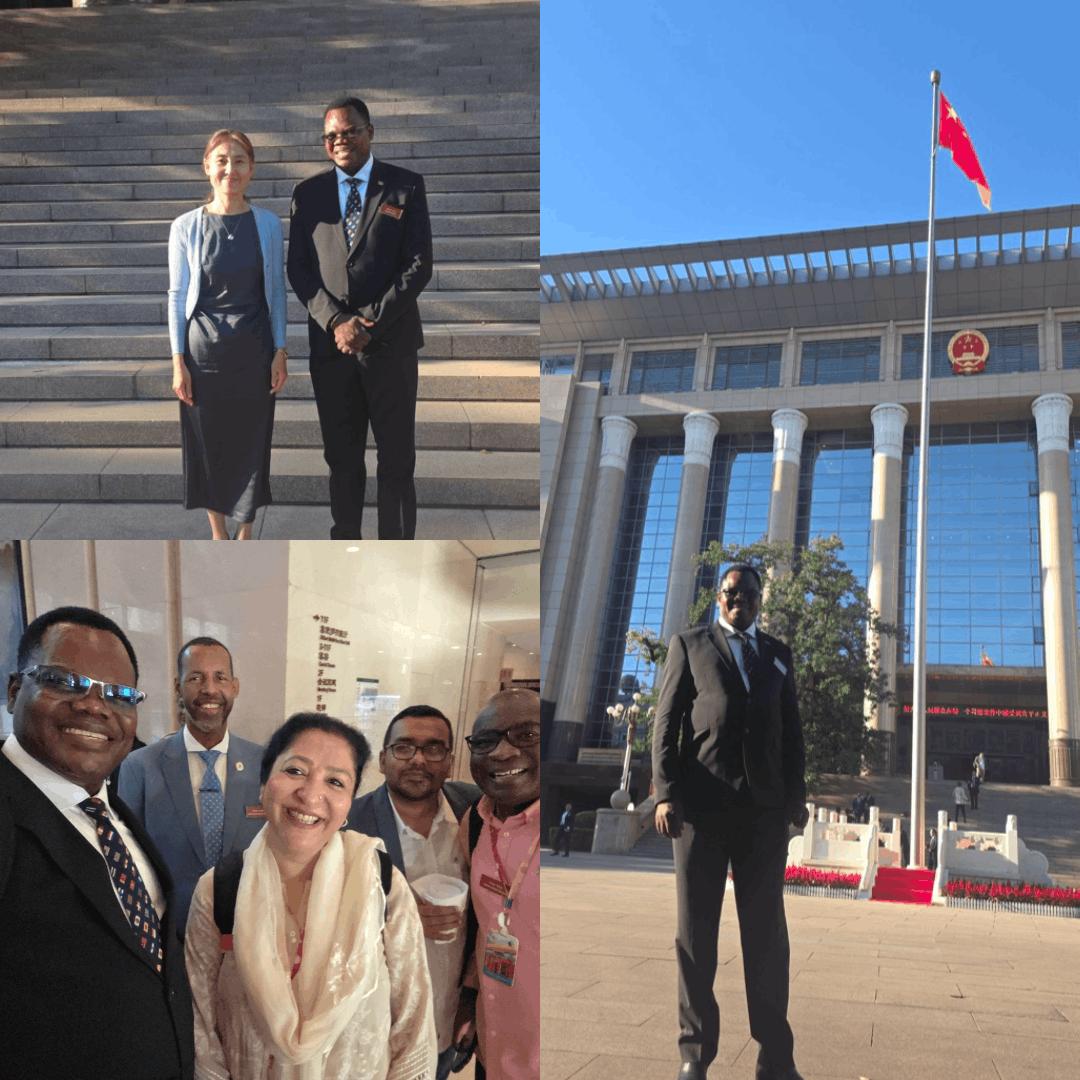

BEIJING — Uganda's Ambassador Dickson Ogwang Okul yesterday held high-level judicial talks with Justice Gao Xiaoli, Vice President of the Supreme People's Court of China, in a landmark exchange that underscored the deepening legal and diplomatic ties between Uganda and the People's Republic of China.
The engagement, held at the Supreme People's Court in Beijing, offered a rare firsthand comparative perspective on contemporary jurisprudence and governance, as Ambassador Okul — a lawyer, former prosecutor, diplomat, and scholar — continues his participation in the prestigious Peking University–Dongfang Scholarship Program.

Ambassador Okul is representing Uganda alongside 56 other leaders and scholars from 57 nations across the globe in the elite academic and diplomatic initiative.
During the dialogue, Justice Gao provided invaluable insights into how China conceptualizes jurisprudence through the lens of the Socialist Rule of Law with Chinese Characteristics — a framework, she explained, that is distinct from Western liberal models founded on strict tripartite separation of powers.
Under this system, the Chinese judicial apparatus operates as a vital pillar of national governance under the leadership of the Communist Party of China (CPC), with the judiciary functioning within a unified state structure under the National People's Congress (NPC). The PRC Constitution serves as the supreme legal authority, while the Party provides political and policy guidance.
The discussion was anchored on several foundational pillars:
1. The Rule of Law: The judiciary operates within a unified state structure under the NPC, with the Constitution as the supreme legal authority and the Party offering political and policy direction.
2. Substantive Justice: Judicial practice emphasizes "Justice for the People," prioritizing substantive outcomes, dispute resolution, anti-corruption safeguards, and social harmony through the integration of statutory law and moral values.
3. Whole-Process People's Democracy: Democratic participation within the legal system is reflected through citizen engagement mechanisms such as the People's Assessor System, public access to open digital judgment databases, and institutionalized community mediation.
Reflecting on the engagement, Ambassador Okul emphasized the importance of cross-jurisprudential dialogue in broadening understanding of diverse constitutional and judicial philosophies.
"As a lawyer, former prosecutor, diplomat, and scholar, cross-jurisprudential dialogues like these are essential," he said. "Understanding diverse constitutional and judicial philosophies broadens our capacity to foster effective bilateral legal cooperation, multilateral understanding, and sustainable governance frameworks that serve our people."
The Ambassador extended his appreciation to the hosts at Peking University, the Dongfang Scholarship Program, and the Supreme People's Court of China for what he described as an "illuminating engagement."
The exchange comes amid strengthening Uganda–China relations across multiple sectors, including trade, infrastructure, and institutional capacity building. Ambassador Okul's participation in the Dongfang Scholarship Program — alongside representatives from 57 nations — positions Uganda at the center of a growing global network of leaders and scholars engaged in comparative governance and legal studies.
Observers note that such high-level judicial exchanges could pave the way for enhanced legal cooperation frameworks between Uganda and China, including potential collaborations in judicial training, legal research, and governance reform.
Dickson Ogwang Okul is a Ugandan lawyer, diplomat, and scholar currently participating in the Peking University–Dongfang Scholarship Program in Beijing, China.