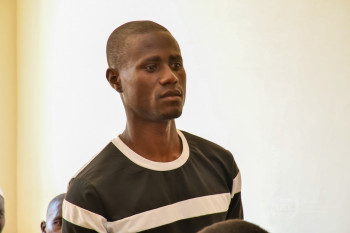
KAMPALA – Fresh off a decisive legal victory for Patrick Obonyo, the lawyer who successfully challenged the Computer Misuse Amendment Act has broken his silence, revealing that his decision to take on the high-profile case was driven by professional duty and conscience—not personal animus toward the bishop who had previously disparaged him.
Okot Bitek Jr., who secured a court ruling dismissing the case against Obonyo, addressed the nation in a statement released shortly after the verdict. The court declared the specific provision under which Obonyo was charged unconstitutional, a ruling that aligns with earlier decisions by the Constitutional Court.
Bitek began by expressing gratitude for the outcome but quickly moved to clarify his motivations.
“My decision to represent Obonyo was not born out of a personal vendetta against the Bishop,” he stated. “Rather, I acted upon professional instructions from the Uganda Law Society and from Obonyo himself.”
The lawyer emphasized that in any functioning justice system, every accused person holds a fundamental right to legal counsel. But he went further, explaining that this particular case transcended one individual.
“Beyond that, this case served a broader purpose shared by many in the legal fraternity—to challenge a law that we believe is retrogressive and repugnant to the doctrines of a modern free society.”
In a striking moment of candor, Bitek acknowledged that Obonyo had previously made “quite disparaging” statements regarding his own personal status. Yet, he chose to accept them and move on.
“I understand that this decision may evoke mixed feelings,” Bitek said. “In fact, Obonyo previously made statements regarding my own status that were quite disparaging. However, I chose to accept them and move on. In that same spirit, I believe it is vital for all parties to tolerate open criticism.”
Perhaps most significantly, the lawyer revealed that Obonyo cannot afford to pay for legal services. Bitek represented him regardless.
“As a human rights activist, I remain steadfast in my commitment to represent those who cannot afford legal fees,” he said. “While Obonyo does not have the means to pay for my services, my conscience dictates that I stand for justice regardless of financial gain.”
Bitek concluded his statement with a broader appeal to Ugandans, urging them to embrace a more open and resilient political culture.
“In a truly free society, we must learn to accommodate a wide spectrum of opinions—both the agreeable and the challenging,” he said.
The ruling has been welcomed by free speech advocates and legal scholars who have long argued that Uganda’s Computer Misuse Amendment Act was being used to stifle dissent. For Bitek, the victory is not just for Obonyo but for the principle that no law should stand if it violates constitutional guarantees.
As the legal fraternity digests the implications of the ruling, Okot Bitek Jr. has made it clear where he stands: on the side of the accused, the unpopular, and the poor whether they thank